Showing posts with label MLS. Show all posts

Sunday, May 22, 2011

A Week Of Great Soccer in the Pacific Northwest

I have made it through the second week of a break from statistical analysis on this blog.  While my Gunners have limped their way to a 4th place finish in the league and face yet another off season of insufficient spending, I have been able to enjoy two great weekends of live soccer here in the Northwest via my Seattle Sounders.  Below are my highlights from the two matches.

Seattle Sounders FC vs. Portland Timbers

I have to admit - I was hopping for the full three points in this derby.  Our back line and goal keeper fell asleep on one free kick, and that cost us the win.

No matter the result, the atmosphere was awesome and I can't wait to see this match on an annual basis.  The crowd was jacked from the get go, with the major supporters groups stoking the flames throughout the match.  Below are a few images and videos that do the best job of capturing the feeling, although nothing is quite like being there.

My hope is that MLS continues to grow and that teams genuinely create rivalries.  I don't know how successful they will be at this given the geographic size of the US and the lack of history many clubs have. I just feel very lucky to be a supporter of a team who has such a storied history with a rival that we don't need to create the derby atmosphere - it existed long before MLS awarded our two cities our franchises.

Here's some tifo from the north end of the field.  The upper right hand corner is the tifo from the 550 away supporters from the Timbers Army.  There were many other Timbers supporters spread out throughout the stadium, a group of which were above us and routinely solicited "PORTLAND SUCKS!" chants from our end of the field.


Here's what the tifo on the south end of the field looked like.  Truly epic!  Grant Wahl referred to it as a "half acre" of tifo.  Four Sounders legends plus Freddy Montero are in the lower bowl, "Decades of Dominance" with a sounder fist crushing a Timbers logo in the upper bowl, and the smiling face in the bottom left is Portland nemesis Roger Levesque.  Tifo that is five sections wide and two bowls high - try and top that!


Here's a video of what the tifo looked like as it came out.  It's too bad the video has some Bach music in the background - far more impressive was the "Welcome to the Jungle" that was played while those banners were flying.  It may be a 25 year-old cliche sporting event song, but it added so much to the mood in the stadium.


More importantly, the videos below capture the scoring action.  The scene after the Fernandez goal was simply electric.


While I was not happy about the equalizer from Portland, the video does a great job capturing 500+ supporters that made the trip up to Seattle and were packed in to the Northeast corner of the stadium.


In all, it was a wonderful derby weekend here in the Northwest, and I am sure we set a new standard for MLS rivalries.  I just wanted those two extra points!

Seattle Sounders FC vs. Sporting Kansas City

In some way you have to feel for the players of Sporting KC.  They've been on one heck of a road trip to begin this season, playing nearly three months on the road while their new stadium is completed in time for the June 9th inaugural match.  The team is certainly investing for the long-run, but it may be doing so at the expense of the near term with a 1-6-1 record and four points to show for it.  MySportsStats.com is showing they have a less than 20% chance of making the playoffs after last night's loss, although my Sounders had even lower chances at a much later stage of last season and still rallied to make the playoffs.  Sporting KC will need something similar this season, and it's not impossible given the benefits of a second half schedule heavy on home matches.

More important to me than the three points was that this was the first Sounders match my older daughter has attended.  She's been watching a number of the matches on TV for nearly a year, so I bought tickets to the match against the Union in July.  This week that match was moved to October to accommodate the Union's friendly against Real Madrid, and I was none too pleased.  I lucked out as I had a friend who had to get rid of tickets to this weekend's match, so I picked them up and my older daughter and I went to it.  The pictures and videos below serve as highlights of a fun evening that I think maybe, just maybe, hooked my older daughter on the live experience.

Below are the two US Open Cups the Sounders have won since moving up to MLS.  It's a bit blurry since the older daughter took it, but it was an awesome experience.


Below is my daughter enjoying the music from Sound Wave, our team's band that plays at every match.

Here's the stoppage time goal from Jeff Parke, who hadn't scored in seven years.  It was an amazing experience - my daughter was picked up off her seat and went for a ride with me as we jumped up and down, high-fived a few people, and generally reveled in an additional two points earned by our boys.

Get Microsoft Silverlight

These kinds of endings seem to be par for the course when Kansas City comes to town - they lost last year's match due to a Mike Fucito stoppage time goal.

Post-match, my daughter and I had a fun time leaving the stadium.  On the way out the door we ran in to a guy who had a giant green foam Z for our fallen winger, Steve Zakuani.  The Spirit of #11 lives as he rehabs from that horrific leg injury he has suffered.


At the end of the walk, we ran in to Sound Wave who was celebrating the win with a rendition of Muse's Knights of Cydonia.  The guy with the giant Z makes another appearance here as well.


My daughter loved every minute of it.  Of course, the match not ending in a nil-nil tie nor the drenched state of the Portland match were definitely plusses.  She's a bit disappointed that she must wait until October for her next one, but I'm sure she'll get over it.  It's all I could ask for with a seven year old - not absolute rejection, and a good interest in going to another match.

Wednesday, May 11, 2011

2011 MLS Salaries: Down from 2010, Up 60% Since 2006, and in Total Equal to the Torres Transfer Fee

So I am only a few days in to my vacation from the blog, and I already feel compelled to break my vow and make a post.  Who can resist analyzing the 2011 MLS player's salaries when such a treasure trove of information is so neatly presented by the MLS player's union?  The topic has been pretty well covered already, but I've covered this topic in the past, am integrating the data into a wider MLS database, and haven't seen too many neat graphs yet.  So why not make a quick post on the topic?

Rather than just focus on the change versus 2010 salaries, I've chosen to focus on all the publicly available data I have that goes back to 2006.  The trends and associated conclusions are interesting, and shed light on how MLS is attempting to manage its financial position within the US sport's landscape.

Player Salaries

MLS's player salaries are very non-normal, so using an average value to make comparisons is not appropriate.  Rather than use the average, the median is used from each season to make comparisons.  The graph below (click on it to enlarge) shows the median player salary by season, the per cent change versus the previous season, and the overall inflation per season versus 2011.


The annual rate of change from one year to the next peaked in 2009 at 33%, just prior to the latest CBA. The terms of the CBA and expansion since it was signed seem to have reversed the growth trend to the point the median salary has dropped by 13% in 2011 versus 2010.  While salaries are down 13% from last year, the median pay is up 60% since 2006.

Salaries aren't the only thing has changed since 2006 - the number of games in a season has also changed.  The 2006 season saw 32 games, 2007 through 2010 had 30 matches, and the 2011 season will have 34 matches.  While not a perfect predictor of the effort required in a season, the number of matches can serve as a proxy for how hard a player is working for their pay.  The graph below (click on it to enlarge) re-plots the data from the graph above, but normalizes it to a per match basis by season.


Given that the 2007 season saw a reduction of 2 matches versus 2006, the pay per match actually went up 7% while gross pay remained flat according to the first graph.  The next three seasons see pay changes identical to the gross numbers shown in the first graph as the number of matches does not change.  The final season (2011) saw a drop in per match pay even bigger than the gross data - 24% reduction versus 13%.

Jeremiah Oshan at SB Nation details some of the reasons why the median player salary has moved down, so I won't recount them here.  Whatever the reason, the median player is earning less than 2010 and working harder to earn it.

Team Payroll

So what is each team spending on payroll over the years?  The graph below (click to enlarge) shows team payroll from 2006 to 2011.  The numbers have been unadjusted for MLS median player salary (more on that later).


The graph shows a steady increase in the team payrolls from just under $2M in 2006 to over $3M in 2011.  Four teams exceeded $4M in 2011 payroll - Chicago, New York, Los Angeles, and Toronto, although the move of Juan Pablo Angel from NY to LA and Dwayne De Rosario from Toronto to NY have lowered the peaks those four teams experienced in 2010.  Clearly, the addition of roster spots in 2011 has boosted the bottom line cost of fielding a squad in 2011 even if the median income of a player has gone down.

So what happens if we baseline everything in 2011 MLS dollars?  Similar to Pay As You Play, a player pay inflation factor (in this case based on wages and not transfer fees) is required.  The change in median player salary is used for such an inflation factor.  The inflation factor for each season shown in the first graph was applied to each player's salary in that season to provide what their equivalent 2011 salary would be.  Those salaries in 2011 MLS dollars were then totaled by team, and are presented in the graph below (click on graph to enlarge).


The inflated 2011 wages from 2006 onwards show two clear conclusions:
  • MLS per team payroll has not increased significantly since 2006 (although the number of teams making such a payroll has).
  • MLS per team payroll was declining from 2008 until this season.
What's also interesting is that the real time payroll differential of LA versus the rest of the league shrinks over time with each year of David Beckham's contract.  Adding Landon Donovan's $2.3M DP contract helped stem the rate of decline in 2010, but it still didn't stop NY from passing LA as the most expensive team in the league.  Of personal note to Sounders fans is the virtual erasure of any payroll cost differential they had the last two years.  They've gone from leading the pack of teams outside the Big Four spenders to falling in line with the rest of that pack.  Parity not only rules on the field, but it rules on the payroll as well.

League Wide Expenditures

So where does this leave the league overall?  The graphs below present two summaries of the same date for the league (click on either to enlarge).  The first looks at the sum of guaranteed contracts over time (unadjusted) and the total count of players with contracts, while the second looks at the rate of change of the total expenditure and number of contracts from one season to the next.


Since the last year of the last CBA (2009), overall league expenditures on pay have risen greatly - an increase of 58% to be exact.  Over the same time, the number of players in the league has increased 34%.  From 2010 to 2011, league pay expenditure increases could not keep pace with the addition of two teams and roster spots on every team meaning that overall pay increased by only 12.5% while the number of players increased by 26%.  This was the first time in the six years of recorded salary data that increases in total team payroll were outpaced by the growth in the total number of contracts.  This is likely a one-time event that we won't see again until another two-team expansion like we witnessed with Portland and Vancouver this year.

Conclusions

The above data confirms that MLS's single entity model provides for a very interesting balancing act - almost like a social democratic economic model.  On the one hand, they need to have some provisions to attract older, top talent from around the world as well as keep up-and-coming talent in the league.  This is their method for fueling league growth and exposure.  At the same time, they're clearly trying to grow the professional sport in the United States in a controlled manner to avoid an NASL-style meltdown.  In the last few years, they also seem to be taking the approach of improving the bottom end of the salary range by a modest amount, and are willing to keep wage growth in the median contracts to a minimum.  It's almost as if the league has taken a "reasonable income for the greatest number approach", as there is not doubt an increasing number of players are able to make a modest income in MLS by playing the game they love.

At the same time, the league wide payroll numbers indicate just how far the league has to go to be competitive on the world stage.  The 2011 league-wide payroll of $80.2M equates to the transfer fee Chelsea paid for Fernando Torres.  That's right - the rights to negotiate on a contract with one player in the EPL cost more than the entire wages of MLS for a season!  MLS has more than doubled what they can spend on wages since 2006 - a sign that both average pay and the size of the league have grown.  But they still have a long ways to go if they wish to compete for top talent on the world stage, and attract enough worldwide attention to be able to pay for such talent.

Monday, April 25, 2011

Steve Zakuani, the Heart and Soul of the Sounders

Happier and healthier days for Steve Zakuani

Being an Arsenal fan, I am a bit sensitive to broken legs on players I love.  I haven't been watching the Gunners long enough to see the laundry list, but I did get to watch Ryan Shawcross's brutal tackle on Aaron Ramsey.  We're now more than a year on from this assault, and Ryan "Not that kind of guy" Shawcross has earned a spot of David Hirshey's Worst XI in the EPL while Ramsey has yet to get back in form for Arsenal's first team.

I got a brutal reminder of what such nasty tackles look like on Friday night when the Sounders' very own Steve Zakuani had his tibia and fibula snapped in half (warning: link shows the brutal carnage, including some pretty gruesome slow-mo of the leg post hit).  And here's the weird Arsenal six degrees of separation involved in this incident - Zakuani, a product of the Arsenal Academy, was taken out by Brian Mullan of the Stan Kroenke-owned Rapids.  Yes, that Stan Kroenke.  There's also the inevitable "he's not that kind of guy" commentary we Arsenal fans are used to hearing - perhaps it's something we Sounders fans should get used to.  It's nice to see that Brian Mullan is doing everything possible to demonstrate he's not that kind of guy (emphasis mine, although I am not the first to make the observation):
"It was never my intention to injure him in the least. It's a tackle that I've done hundreds of times and would probably do again. I had no intention of hurting him. It's a freak, freak thing, and I apologize and wish Steve a speedy recovery."
Sounder at Heart has some advice for Mullan, and he should heed it.  It's not like he didn't exhibit guilt in the video replay, where you can clearly see Mullan size up Zakuani and take out his frustrations from an earlier non call on his leg. With both feet. Studs up. But he's not that kind of guy.

Enough with the dirty tackle stuff.  This blog is about statistics, and here are Steve's:
  • 2009 (rookie season): 4 goals and 4 assists, making him a finalist for rookie of the year.
  • 2010: 10 goals and 6 assists, which allowed him to share the team's golden boot with Fredy Montero.  Half of those scoring contributions came in the critical back half of the season, where he and Montero led the Sounders back from the near bottom of the table to the fourth playoff seed in the West.
  • 2011: In six games he had already scored two goals and two assists.
The most important statistic is this one: Seattle's first ever draft pick and #1 overall pick when Seattle entered the league in 2009.  He wasn't the first Sounder - guys like Roger Levesque who were holdovers from the USL side and new players like Kasey Keller were signed well before the first season.  But those guys don't represent the sacrosanct "first pick" in American sports.  As in most other US sports, MLS allocates their college and non-academy players via a draft.  These players represent the eternal hope of team getting lucky and finding a franchise player that plays for them at an early age and from day one.  Along with Montero, Steve represents the long term future upon which the club is built.

Beyond his on-pitch performance, Steve also served as spark plug elsewhere in the team.  Steve's one of the most loved players on the Sounders. He has a huge heart for the team, the city, and the supporters.  He's a humanitarian with few equals.  He's always sporting a wonderful smile no matter the occasion and leads the response to any huge plays by he and his teammates.  His face is so central to the team that a picture of him in post-US Open Cup celebration was all that was used for the banner ad for season tickets this off-season.  Talk all you want about DP's on the Sounders (we've had our fare share of them), but this is the guy who makes the offense tick statistically and emotionally.  His absence will be felt by everyone on the pitch and in the stands.

Realistically, Steve's season is over and his career may never be the same.  We all hope that he works his way back in to the same form as he was in to start this season, but the realistic part of me accepts that he may not.  Up until Friday night this had been an over two year journey for him and the team to get into the form he's demonstrated.  It's been more than his individual talents, and has relied a good bit on rhythm and experience with other teammates he's been around for more than two seasons now.  He was hitting stride this season, one I've highlighted as do-or-die for this crop of Sounders in a previous post.  Who knows what teammates he'll come back to next season.

Regardless of his ability to come back and play, Steve deserves our love and support right now. Hopefully he'll be able to draw strength from the team and supporters who are already planning tributes to him at the next home match, and maybe a last little bit of inspiration from Charlie Davies who's faced a similar horrific injury and has come back from it to lead the golden boot competition early in this season.  Sounder At Heart has the priorities straight, ones we should all keep in mind.  Get well Steve - we can't wait for you to be trending on Twitter again for a reason other than an injury!

Wednesday, March 30, 2011

An Indictment of the MLS Playoff Structure, Part 4: Quantifying the Impact of Game Differential on First Round Odds

In my last post I used binary logistic regression (BLR) to show the impact of various EPL match attributes on the likelihood of winning a match.  Soon after beginning the work I thought of another good use for a BLR model - identifying the factors that truly matter in predicting (as compared to retrospectively assessing) first round MLS playoff success.  Regular readers know I am no fan of MLS's playoff system that seems to buck the trend of most leagues using a top-of-the-table format to determine their champion.  I took a pass at explaining the phenomenon of teams with fewer games played winning a disproportionate share of first round series since 2003, but at the time could not prove that it was one of the few statistically significant predictors from the many identified by Climbing the Ladder (CTL).  Since then I have used CTL's lineup database to construct a BLR model of the major factors identified by CTL and isolated the statistically significant factors.  The results suggest that MLS has a lot of changes to make to continue to improve their playoff format they seem to love so much.

The Data Set and a Few Summary Statistics

I utilized CTL's lineup database to create the following statistics:

  • Difference in the number of games played
  • Overall goal difference
  • Difference in coach experience (MLS games only)
  • Difference in seeds
  • Home record difference
  • Away record difference
  • Regular season goal differential between the two teams
Here are a few interesting summary statistics regarding several of the attributes above for the 2003 through 2010 seasons:
  • Games played difference: The maximum difference came in the 2008 NY/Columbus series where the Crew played 14 more games than the Red Bulls.  This was due to the Crew playing in both the old and new format for CONCACAF Champions League (CCL).  The median differential is 2 games.
  • Overall goal difference: 2005 through 2007 saw some of the highest overall goal differentials between first round playoff participants - one series each with 22 and 23 goals, and two series with 27.  The median goal differential was 9 goals.
  • Difference in coach experience: Sigi Schmid is the king of mismatches in manager experience with the largest gap of 196 games realized when his 2008 Columbus Crew defeated the Kansas City Wizards.  The median difference is 68 matches.
  • Regular season goal differential between the two teams: The peak of regular season goal differential between two teams was witnessed in the 2006 through 2008 seasons, when an unbalanced schedule saw teams play each other up to four times during the regular season.  Chicago's 2008 first round series versus New England witnessed the largest such goal differential - 8 from four regular season games.  Chicago went on to win that first round series, while the median value for the first round series is 2. 

The Results of the BLR

After compiling the data for every first round playoff series from 2003 through 2010, a BLR was constructed to predict the likelihood of a team winning the series.  Dummy variables for each year were constructed to ensure no special causes were missed.  Terms having a p-value greater than 0.05 were successfully eliminated until only two terms remained: manager experience differential and games played differential.  All other terms - overall goal difference, difference in seeds, home record difference, away record difference, and regular season goal difference - were not significant by a mile (most p-values were equal to or greater than 0.40).

Plots of the the changing odds with various manager experience and game differentials is shown below.


The plot of manager experience differential is counter intuitive, but is born out by the statistics.  Apparently having a less experienced manager actually bodes well for a team in the first round.  Perhaps it is that long term managers have more data points in the MLS playoffs, increasing the likelihood that the random nature of the playoffs will lead to their increased number of losses.  Perhaps newer, less experienced managers can take a team by surprise, or are managing teams that do not perform well the prior season and thus align with the teams with fewer matches.  Whatever the cause, it seems that fewer games for a manager, relative to the opposition team's manager, bodes well for the team with the less experienced manager.

More interesting is the intuitive relationship between the game played differential and the likelihood of winning the first round playoff series.  The equation provides a very clear relationship between the game played differential and resultant odds.  The relationship is largely linear from -5 to 5, meaning that it's about a 7.5% change in odds for each incremental game difference.  As game differential approaches more than five matches, the incremental benefit of increased or reduced game differential is minimal.

What does this mean for the 2011 playoffs?  The most direct assessment is that MLS missed a golden opportunity to correct this imbalance by not going to a two game series in the first round of the playoffs.  I commented here how I would have liked to have seen such a re-balancing prior to MLS's announcement of the 2011 format, as well as my reaction to the announcement that the first round would be a single match while the second round will have the usual two-match series.  If history is any indication, MLS essentially gave the lower seeds a 7.5% advantage in odds of advancing to the conference final by not making them play an extra game in the opening round.

We'll see how things play out in the 2011 playoffs and will update this study once they're complete, but I am not holding out hope.  With my Sounders having one of the league's more experience managers and their desire to go deep in the US Open Cup and CCL, I think it will be another year without an MLS Cup.

Perhaps MLS really does like this parity that borders on complete unpredictability.  Allowing MLS clubs to buy championships like Chelsea is not what I want, but the fact that no prior rational metric correlates to first round playoff success suggests MLS has some major adjustments to make.  It seems as if MLS has swung the pendulum so far to the side of parity that no club's supporters know what to expect from regular to post-season, let alone year-in and year-out.  Ultimately, this holds back the professional game's success and growth in this country.

Monday, March 14, 2011

Random Thoughts on the Upcoming MLS Season

Sorry, Colorado fans. This image won't repeat itself in 2011.

The MLS season kicks off Tuesday night (I'll be there as part of the toughest crowd in MLS), so I thought it would be appropriate to share a few random, largely non-statistical thoughts about the upcoming season.
  • I don't believe Colorado will repeat as champions.  Whether it's the parity in the league, or a Real Salt Lake side coming back stronger than ever, or the fact that Colorado will be competing in the CONCACAF Champions League and will likely have the dreaded "four more games curse" come playoff time, I just think the cards are stacked against them.  No offense to Colorado fans, but I just don't think the team is good enough given the Western Conference being stacked again this year.
  • Recall that in this post I quantified the relationship between table position and the percentage of points available.  That regression equation predicts that the Supporter's Shield winner should earn 68 points this year, nine more points than LA earned last year with four fewer games than this year.  I think this is a bit of a high prediction that is the result of the bias in the model due to the steady increase in the number of teams over the last few seasons, but it does provide a useful starting point.  I am going to say that it will take at least 64 points (62.7% of available points) to win the Shield.  This represents the a slightly higher-than-average percentage of points for a Shield winner (the average is around 61%), which I'll chalk up to each team getting four additional matches against the two expansion franchises this year where the top teams should be able to pick up 7 to 9 points more than they had last year.  This also accounts for LA's second highest point percentage ever last season (65.6%), and that I don't think we're going to see such a high point total again this season.
  • At the opposite end, I see the projected points for the last playoff spot (10th overall) correlating to the percentage projected in this post: 44.3% or 46 points.  The regression model has been relatively accurate in the lower places, so I am confident in using its predicted number.
  • Seattle fans better prepare themselves for a disappointing season.  I am such a fan, but I am forcing myself to be a realist.  For all the talk of this season being make or break for the Sounders, I don't think they've done enough to compete for an MLS Cup - so significant additions and some pretty substantial losses in Nyassi amongst others.  Add in yet another CCL run if they get past the play-in stage again, and the annual deep run in the US Open Cup, and I think they don't have enough gas left come playoff time.  If that is the case, it will be interesting to see what off season moves, besides the retirement of Keller and Nkufo, are made and how the fans react to it.  Seattle is no longer the cool new kid on the block with minimal expectations, and it will be interesting to see how the team and fans react if the high pressure expectations aren't met.
  • The same might be said of the Galaxy.  Unlike last year, they're automatically into the group stage of the CCL.  This gives them six more matches than every other MLS team other than Colorado (and perhaps Seattle and Dallas), and all of those games are in the second half of the season.  Throw in a few more games from the US Open Cup, and LA begins to build a resume that includes a much greater number of games than their likely first or second round opposition in the MLS Cup playoffs.
  • I am very excited for the addition of the Vancouver and Portland teams, but I get the feeling that Vancouver is the red-headed stepchild of the three teams in the Northwest .  It seems that the Seattle-Portland rivalry is the most intense of the three.  The speed with which the recent Sounders/Timbers friendly and the regular season match at Qwest Field sold out, while the Sounders and Whitecaps struggled to fill their Cascadia Summit match, speaks volumes as to where the intensity lies in the Cascadia Cup.  Beyond the rivalry on the pitch, Seattle and Portland generally dislike each other in every other aspect as well.  The whole Cascadia Cup rivalry will be great, but I suspect it will be the most intense between Portland and Seattle.
  • In the East, it will be interesting to watch how Philadelphia and New York perform.  New York's second year of their two key DP's - Thierry Henry and Rafael Marquez - are expected to deliver with outstanding young talent like Juan Agudelo surrounding them.  Last season was one where adjustment was expected and tolerated, but not this season.  In Philly, this was a team that had a respectable 35 goals scored - it doesn't sound like a lot but it does represent the 10th highest total in 2010.  Get a few more goals this year (especially from an outstanding Le Toux), let in fewer than the 49 they let in last year (especially on the road), and a 10th place finish and qualification for the playoffs isn't impossible.
  • Finally, it will be interesting to watch how the DC United rebound from their worst season ever - 22 points/-26 GD, futility only surpassed the last six seasons by New York in 2009 and Real Salt Lake's first season in 2005.  Beyond the quality of play on the pitch, they need to get a soccer-specific stadium built in the next few years or risk being permanently relegated to the lower half of the league in terms of public perception.  Past glory won't do, and DC United's leadership knows this.
It'll be interesting to see how things play out.  There are so many stories at the outset of this season - those are only the few I was able to write about.  I'll check back in on a quarterly basis to show which teams are under and over performing historical expectations.  It's going to be a fun season.  Enjoy it!

Wednesday, February 23, 2011

A Few Quick Reactions to the 2011 MLS Playoff Format

MLS has finally released their 2011 playoff format, and I certainly have a few ideas based upon my series I did on their past playoff formats and outcomes.  I dealt with my recommendations for the 2011 format in this post.
  1. The format largely follows what I outlined in my "Recommendations for 2011" in this post.  The top six get a bye, the Supporter's Shield winner gets the lowest seeded team out of the wild card round, and we generally eliminate all the crossing over from conferences found in the last few seasons.
  2. What I don't understand is why the wild card round is one match, then the conference semifinals are two legged, and then the conference finals and MLS Cup are back to single matches.  This makes no sense, and it just seems like MLS is trying to follow previous playoff formats in some desperate attempt the provide continuity.  A much better, and natural, approach would have made the wild card round a two legged series of matches.  This would not only provide a natural progression via a reduced number of matches each round, but it would also add two critical matches to the lower seeds and close the likely gap in matches played between them and their second round competition.
  3. Yet again, the Supporter's Shield winner gets minimal benefit.  If the two-legged series was played in in the wild card round, the Supporter's Shield winner would be guaranteed to play all their playoff games at home and benefit from MLS's outstanding home field advantage.
  4. MLS didn't announce the location for the MLS Cup yet, so we'll reserve judgement on my recommendation to allow the highest seeded team of the final two to host it.
  5. MLS needs to stop making excuses for this awful playoff format.  The story on their website is chock full of excuses from the league.  Here are a few samples:
"It will mean that the battle and the race for the playoffs will have added intensity and last longer through the regular season. And that, on balance, should be a good thing for the play on the field, and for the fans in the stands and at home."
This statement defies logic.  Letting in the highest proportion of teams to the playoffs in over five years won't enhance competition, it will dilute it.  You can't have the lowest standard of admission, with the greatest number of teams admitted in the history of the league, and think that it won't bring more parity and a lower standard of playoff team as a result.
“There are so many variables that any system is imperfect in that regard,” Rodriguez said. “You could be facing the lowest-remaining seed who’s on a 10-game winning streak to close the season and they’re the hottest team in the league. … Any playoff system has, within it, some fault or a flaw that could easily be pointed to.”
Not if you followed my recommendations and kept the two-legged series in the Wild Card round!  MLS is seriously trying to blame "the random nature of the playoffs" to excuse their failure to properly design a playoff system over which they have total control.
“At the end of the day, you try to create a playoff system that is fair and relatable to the regular season,
This is only the case if MLS's goal is the complete random nature of a league that exhibits the most parity of any US pro league (too much parity, in my opinion).  Perhaps it's that parity and the random results it produced that led to the awful MLS Cup ratings last year?

I can only hope MLS is serious in their desire to "spend the next bit of time trying to finalize a long-term playoff situation that can take us into the future."  We deserve a better system for determining the MLS champion.

Sunday, January 30, 2011

An Indictment of the MLS Playoff Structure, Part 3: Making the Best of a Bad Situation

Note: This the third and final post in a several part series that I have written about MLS's playoff structure and how it penalizes successful teams.

In my first two posts in this series I highlighted the effects of letting too many teams into the MLS playoffs and the resultant penalty good teams pay in the playoffs by playing a greater number of games during the regular season via domestic and international competitions.  In this post I will focus on solutions to these problems.  I use the byline "Making the Best of a Bad Situation" in this blog post's title because we all know that Don Garber and MLS will not ditch a playoff format - they are (mistakenly) wedded to the idea that US soccer fans want a league that is eventually the size of the NFL and requires a playoff format to determine its champion.  So, after listing my ideal solution, I will spend time exploring how the 2011 playoffs could be formatted to make the best of the already announced 10 team playoff field.  I will then move on to how future seasons might benefit from a reduced number of playoff teams and modified formats.

The Ideal Solution

Before I delve into making the best of the poor hand dealt to us by MLS, I would like to lay out what I envision would be the ideal format for determining MLS championships.
  1. Limit MLS to 20 teams: This preserves the ability to run a balanced schedule.  Perhaps I am writing from a bit of personal interest, but a balanced home-and-away schedule is the most fair to the teams and is great at providing statistical insight.  Each team gets to play every other one twice, and home pitch advantage is effectively wiped out.  Such a format is critical in delivering my second recommendation.
  2. Play a top-of-the-table championship format: After 38 matches, we would truly understand who was the best overall team throughout the season.  No upsets allowing eighth seeded teams to knock out the number one seed.  No poor form for half to two-thirds of season that is bailed out by a hot run at the end of the season.  There's a reason the rest of the world runs such a  format - it provides stability to the teams and supporters and justly rewards good long term performance.
  3. Reform CCL qualification: If (2) is realized, the US Open Cup then becomes the major domestic knock-out tournament just like most other national tournaments.  Make the US Open Cup championship worth something - make it the automatically qualifier for CCL group play along with the MLS top-of-the-table champions.  To add drama and competition to the MLS single table format, make the second place team the play-in for CCL.  Overall, this would provide greater incentive for winning the US Open Cup and ensure our CCL teams truly are the best MLS has to offer.
  4. Implement promotion and relegation: This system works in nearly every other soccer nation.  For those who worry about the health of MLS and soccer in the US, they should realize that attendance at matches in the US rival those found in top leagues outside of England, Germany, and Spain.  What is holding back growth in the US is MLS's obscene franchise system and associated fees.  Such high barriers to entry stifle the development of the lower tiers of the US soccer pyramid, and are not found in other parts of the world.  When soccer rich cities like St. Louis can't field a second tier professional team and the entire second tier is at risk of losing its sanction because of financial difficulties, it's clear something has to change.  Simply put, the closed market, single entity concept is holding back the development of the professional game and our national team.  It's a hurdle not found in other countries, where teams who work their butts off at lower levels earn the just reward of promotion without having to pay the cartel and extra entry fee.
I am not delusional.  As I said at the outset, I think this proposal would never be implemented.  The main reason is that it runs counter to every fiber of American professional sports, which are all about the league and guaranteed revenue and not the team.  Team success (both on the field and financially) is only allowed in so much as it builds the league's product.  The league redistributes the earnings from team merchandise, stadium revenue, and TV revenue - more so than they do in soccer leagues in places like Europe.  If the league doesn't like the deal one of its owners is getting in a town, they support uprooting the team and moving them to another state or a completely different section of the country - we're talking a much bigger relocation than Tottenham's potential move to the Olympic Stadium (and resultant supporter resistance).  In the United Stats it's about moving a basketball team from Seattle to Oklahoma City or a soccer team from San Jose to Houston.  As is often the case, such moves are condoned by the league because local tax payers are unwilling to be held hostage to build a new stadium that the teams are unwilling to finance themselves (precisely because the stadium is more expensive than the team can justify paying for themselves).  Moving towards a promotion/relegation single table format that rewarded consistent performance would encourage reasonable growth at multiple levels of the professional game, improve the quality of our national team by developing more talent, and avoid the boom bust cycles of the original NASL and first decade of MLS's

So if the ideal solution is not a realistic one, how can we make the best of a bad single entity playoff solution?  How can a full season's effort be rewarded come playoff time?  The answer is two fold - one solution for the 2011 season that will see 10 playoff teams, and another for subsequent seasons where the number of playoff teams is still undetermined.

Recommendations for 2011

Given that MLS has indicated they will break 10 of the 19 teams to the playoffs for the 2011 season, how can the as-yet-undefined format be defined so as to reward regular season play and not make it an afterthought as it currently is regarded?  Here are a few suggestions.
  1. Give the top six finishers a bye:  If we want to encourage teams to compete for playoff position from top to bottom, we need to give them a just reward for their successful efforts.  Currently, there is no real advantage to being a top seed.  Giving seeds 1 through 6 a bye, which would effectively give them two weeks between their final regular season match and their first playoff match, would give them much needed rest after a grueling regular season, US Open Cup, and CCL group play.
  2. Make seeds 7 through 10 play a two-leg first round: Making the lower seeds play two extra games will help level the playing field when it comes to game differential.  Such an approach would have moved 5 of the 12 series from 2003-2010 that had a game differential of four or more to series with a game differential of three or less - crossing to the right side of the magical four game differential I highlighted in my last post in this series.  I'd also make them play it on a weekend/weekday swing, which would essentially make the winner of the series play three games in seven days when the second round match was factored in.  Meanwhile, the team they faced would be coming off two weeks rest.
  3. Make away goals count for more than home goals in the first round: Nearly every other two-leg knockout round competition uses this rule.  For some unexplainable reason, MLS does not.  Such a change would reward risk taking by away sides, and recognize the inherent difficulty in scoring goals away from home.  It would also likely help minimize the number of opening round matches that went to overtime and PK's in the second match.
  4. Re-seed after every round: Implicit in this suggestion is the request to forget about conferences once the playoffs start.  The reward for finishing with the best overall point total (or tie breaker) should be that that the highest seeded team host the "weakest" team each round.  Higher seeded teams shouldn't be forced to travel or endure any hardships come playoff time if they've worked their rears off for 34+ matches.  This will also help to eliminate MLS's current crossover system that has the propensity to hurt top performers.  Case in point: in 2010 the Western Conference took six of the available eight playoff spots, yet the bottom two teams crossed over to play the two Eastern Conference teams, both of which had lower point totals than the top two teams in the Western Conference
  5. Take advantage of MLS's superior home field advantage:  As Scorecasting has shown, MLS teams have the greatest home field advantage of any US sports league or major soccer league world wide.  Let's put that to good use and provide greater rewards to superior regular season performance.  MLS should not only re-seed the matchups every round, but they should also have the higher of the two MLS Cup participants host the championship match.  Therefore, there truly is a benefit to winning the Supporters' Shield - controlling one's own destiny as to where matches are played all the way through the playoffs.
Announcement of the 2011 playoff format is expected any day now.  We'll see if any of the changes conform to the suggestions above.

A New Playoff Format for 2012 and Beyond

By 2012 MLS will have its 19th franchise (Montreal), unbalanced conferences, and possibly an unbalanced schedule again.  Everyone fully expects the league to expand further, not stopping at the 20 teams found in most other domestic leagues.  How should their playoff format change to match these changes and improve the quality of the playoffs?
  1. Run a single table, and break only the top six teams to the playoffs: With Montreal in the league, there will be no way to balance the conferences.  This would be a perfect opportunity for the league to convert to a single table.  Limiting the playoffs to the top six will also greatly improve the quality of teams that make it in.  The regression equations developed in the first post in this series indicate a team in the top six would need to earn 51.5% of the available points and have a goal differential of nearly 8 - both are massive improvements over the numbers required since 2005.  It would also lower the percentage of teams that make the playoffs to 31%, making it the second lowest percentage of the US professional leagues profiled in my first post.
  2. Use the same suggested play-in format from 2011 for seeds 3 through 6:  Again, it will cut down on game differential in the second round, provide greater incentive for finishing in the top two via an extra week of rest, and will ensure away goals count for more.
  3. Re-seed for the semifinals just like 2011, and have the higher seed host MLS Cup: Give good teams every advantage they deserve for sustained quality throughout the regular season.
  4. Reform CCL qualification along the lines of (3) in the "Ideal Solution" section of this post.
We're at least a year away from Commissioner Garber announcing anything about the 2012 playoff format.  I suspect he will resist any attempt to go to a single table, especially when such a format becomes difficult to maintain given the geographic reality of the league and his continued desire to expand beyond twenty teams.  Nonetheless, following the rest of my suggestions would greatly improve the quality of teams that make the playoffs.

Conclusions

It's clear that MLS is intent on keeping a playoff format to determine their champion, as they mistakenly believe that US soccer fans and fans of other sports that they are trying to attract want an Americanized version of the world's game.  If this is the case, there is a right way and a wrong way to implement a playoff system.  Right now, MLS is going about it the wrong way.  They are letting way too many teams into the playoffs, and the resultant chaos turns fans off as there seems to be absolutely zero reward for an entire season of hard work.  The wide open playoff format, combined with commitments outside of MLS, has produced little predictability from one season to the next.  If MLS is to insist on having a playoff format, it is my hope that they adopt a number of the proposals made above.  Restricting the number of overall participants, and forcing lower seeds to play more games in the playoffs, will improve the chances of higher seeds making it through to the MLS Cup and hopefully provide some predictability to the current chaos that is the MLS Playoffs.

Friday, January 21, 2011

Friday Night Links

I am going to try and start a new, regular post that summarizes my favorite articles and blog posts that I came across the previous week.  They may provide a less numerical look at soccer, but I hope you find them insightful nonetheless.
Until next week...

Friday, January 14, 2011

Ruining Northwest Rivalries in The Name of MLS Brand Recognition

What MLS Wants But Cannot Have
(Sounders Vs. Timbers US Open Cup Match)

I try to stay away from opinion pieces, and instead let data drive what I write about.  One topic where that doesn't always apply is the single-entity nature of Major League Soccer (MLS).  I much prefer the open league, promotion/relegation, club model found in the rest of the world.  It forces teams to justify they're good enough to continue playing in the league (*cough* LA Clippers *cough* Detroit Lions), it often prevents clubs from bilking people who don't attend the matches with the cost of a stadium, and generally drives real allegiances between teams and supporters (and by consequence, rivalries between teams and their supporters).

MLS, like many other US sports leagues, does not follow this model.  It's a closed market league, where the clubs who pay enough money get the right to be a franchise within the league.  Greater focus is paid on league brand than individual club brands, the league will condone the relocation of a team if the tax payers refuse to give in to the often ludicrous public financing of stadiums requested by the franchises and the league, and the league artificially depresses player wages by owning all the contracts and setting a very low salary cap.  Does anyone blame Edson Buddle for signing with a second-tier German team who is rumored to be paying him four times more than the Galaxy's best offer?

At the end of the day, we US soccer fans want the game and governance that the rest of the world enjoys, not an Americanized version whose only justification is to protect owner and league leadership interests at the expense of players and supporters.

Don Garber and MLS took the single-entity insult to a new level yesterday by suggesting the concept of a rivalry week.
The commissioner also said that the conference alignment and playoff format is close to being finalized. And to further intensify the Pacific Northwest rivalry between Seattle, Portland and Vancouver, Garber said MLS is strongly considering a week-long round robin between the clubs -- three regular season matches in a span of a week or so (Van vs. Sea, Sea vs. Port, Port vs. Van).
Apparently Don Garber and the MLS brass have zero understanding of the markets into which they are expanding. We, the supporters of these clubs, don't need any help in intensifying the rivalry.  It's already hot enough, thank you very much.  My Sounders sell out 36,000 seats to every game whether it's the New England Revolution or our rivals to the north or south.  We may have to consider opening up more space when the Timbers and Whitecaps come to town.  Meanwhile, most franchises in the league are struggling to get anywhere north of 15k-16k fans per match.  My Sounders have worked to get 500 away supporter seats assigned for matches against our two local rivals, 350 more than the league requirement and still too few in my opinion.  We have a history that pre-dates MLS's, and frankly now is trying to be co-opted by MLS in the worst way.  We did this without the help of MLS, and perhaps MLS should spend more time studying how we've achieved this success instead of trying to artificially create it.

Why does this all matter?  Because it's we, the supporters and fans, who are the lifeblood of soccer in the United States.  We want to go to the stadiums to see our teams play, and it is our support that is the envy of the rest of the league's teams.  We show up match after match, setting attendance records in MLS and the US Open Cup, and want to especially do so when the Timbers and Whitecaps are in town.  We love our team so much that we will travel to Portland or Vancouver to see our team play, even if it means most of us will be outside of the sanctioned supporters area and spread all over the opposing franchise's stadium.  This is the dedication to a team that develops real, and not manufactured, rivalries.  Playing a rivalry week would kill that opportunity to travel to the opposing rivals' stadiums, and we've consistently asked that all Sounders/Timbers/Whitecaps matches be put on weekends (preferably Saturdays) to facilitate such travel.  Garber's suggest Rivalry Week is total rejection of that request.

I use possessive terms like "my" and "we" to demonstrate the gap between Commissioner Garber's publicly stated goal and his privately stated one.  This proposal has NOTHING to do with fostering real rivalries - if it did he'd listen to the supporters and put all of the matches on the weekends.  Instead, it's all about manufacturing fake rivalries for broadcast on TV for the purposes of enhancing MLS's brand recognition.  It's the same mentality that is behind the manufactured drama of reality TV - call it "Jersey Shore, MLS-style."  In the end, this proposal is all about sacrificing the will and desires of those who really pay MLS's bills and kept the league alive during its darkest hours - the supporters - for the dream of having the MLS brand compete with the likes of the other US pro leagues.  It's all about putting the league first, and teams and their supporters second.

Commissioner Garber, thank you very much for your suggestion.  Frankly, it's not a very good one, is completely unnecessary, and is counterproductive to you publicly stated goal. How about you actually study how the Timbers, Sounders, and Whitecaps built and maintained committed fan bases without the help of MLS (and often times in spite of it) instead of exhibiting stereotypical single entity behavior.  That would ensure you learn the best practices of building clubs loved by supporters, which in turn builds real love for the competition present in a league in which those clubs participate.  Then MLS's brand will truly rise within the American sports landscape and the global soccer community.

Wednesday, January 12, 2011

An Indictment of the MLS Playoff Structure, Part 2: Too Many Games for the Good Teams

Note: This is the second post of a several part series that I will be writing about MLS’ playoff structure and how it penalizes successful teams. Part one is located here.

In my first post in this series, I explained how MLS’s current playoff structure and generous standards to determine which teams make the playoffs has lead to a number of eighth seeds with losing records that have made it deep into the playoffs (including appearing in two of the last three MLS Cups). In this post, I will explain how the disparity in the number of games played throughout the regular season contributes to the predictable outcome of a first round playoff match, and why it seems to uniquely penalize the higher seeded teams.

Factors In Predicting MLS First Round Playoff Outcomes

Climbing the Ladder had a great post right after the conclusion of the first round of the 2010 playoffs were different factors that had contributed to first round playoff success since 2003 were compared to each other. A snapshot of the table that was developed is shown below.


What was interesting is that fewer games, out of all the factors studied, stands out as the most significant determinant of first round playoff success. This seems a bit unexpected to those versed in how the US game operates, and I will explain why in a bit. The next most significant factor – regular season goal difference – does make a good bit more sense. The less significant coach field is much like the fewer games category - the results are a bit opposed to what our first guess might suggest. As the comments in the original post evolved, it became clear that everyone wanted to focus on the “fewer games played” category. Here’s why.

While MLS plays a balanced schedule in their regular season, their teams have three other types of matches they can play.

  • Friendlies: The number of friendlies a team plays is under the direct control of the team management, and varies from team-to-team. Teams may use them as pre-season conditioning or as mid-season revenue generators. I’ve seen both approaches from my hometown team, the Seattle Sounders. Regardless, they demand match preparation and player conditioning, even though the starting XI may get changed from the side that participates in a typical MLS match. While teams somewhat enjoy them, a growing number of fans aren’t. Seattle’s supporters have been so vocal as to create a Twitter hashtag to emphasize their displeasure, which was subsequently picked up by Real Salt Lake. Perhaps the supporters are on to something – if you’re going to lower the chances of the team making it deep into the MLS Cup Playoffs, don’t do it with a meaningless friendly.
  • CONCACAF Champions League (CCL): Like every other continental governing body, CONCACAF has a tournament where the best teams from each league play each other to determine which club is the best from that governing body. Winners of the CCL move on to the Club World Cup. While the format for the CCL has changed over the years, it has followed a 4 team-per-group, 6 game balanced-schedule-within-group format since 2008. While the standards for MLS CCL qualification has also changed over time, currently the MLS Cup champion and Supporter’s Shield winner are guaranteed a spot in group play, while the MLS Cup runner up and US Open Cup champion must play a two-legged play-in via the preliminary round. This means MLS CCL participants can play an additional two to eight matches during their MLS regular season, depending on qualification path. As the CCL follows the FIFA calendar, the six games a team may play in the Championship Round of the tournament occur at the beginning of the next MLS season. Thus, if a team qualifies for the Championship Round in one CCL tournament and qualifies for the Preliminary/Group Play stage in another, they may play up to fourteen additional matches in a season.
  • US Open Cup: The longest running soccer cup competition in the United States has been contested since 1914. Thirty-two teams from the lower divisions of the American soccer pyramid begin the tournament in June, with eight MLS teams being added to the third round to compete against the eight remaining teams from the lower levels of the pyramid. MLS teams must play four matches in the tournament to win the US Open Cup. MLS assigns its berths in the tournament by giving its top six teams (by points) automatic berths and the remaining teams compete for a berth via a playoff format. Thus, MLS teams can play between four and eight matches in qualification and participation in the US Open Cup.
Adding up all these competitions, an MLS team can play between 1 and 22 additional matches in a season (not including friendlies). The reality is that with so many MLS teams competing in each competition and each team making it to various stages of each tournament, the disparity in games played between each team is much lower. The highest game difference was the 2008 first round match-up between Columbus and New York where New York had played fourteen fewer games. The average difference in games played between first round opponents since 2003 is 3.28 (median of 2.0).

All of this makes for a pretty compelling case that game differential may play a significant roll in the first round. This seems intuitive – teams that make it deeper into competitions outside of MLS will have played more matches, and fatigue at the end of the long season may take a bigger toll on those teams. Combine fatigue with the wild nature of a playoff, and you have a recipe for the team who has played fewer games to win. This seems a bit unfair, as the only way these teams have played more games is that they finished well the season prior (qualifying for the CCL) and/or have played well in the US Open Cup (in trying to qualify for next season’s CCL). The US soccer landscape already has two knockout style championships, so why does MLS feel the need to add the unpredictability of a third?

Testing the Data Statistically: How Playing Fewer Games Leads To Upsets

All of those observations are just idle speculation if they can’t be backed up by statistics showing the difference in games played actually upending expected results. Interestingly, the statistics present a mixed answer that suggests MLS may just be proceeding down the path of unintended upsets in how their playoff structure interacts with the teams’ other competitions.

The first comparison that was studied was Climbing the Ladder's observation regarding the overall impact o fewer games. In this case, it must be determined if the sample size is large enough (enough playoff games played since 2003) to determine if the observed effect is statistically significant. This entails comparing the expected percentage for overall first round playoff matches (50% chance of winning the series) to the observed percentage for teams that win and have played fewer games throughout the season (67.2%). As my comment in the original Climbing the Ladder post suggests:
Sadly, even the "fewer games" category is not statistically significant when compared to the 50/50 chance most teams have of advancing. Using this site and entering the following values:
p0 = 0.5
p1 = 0.672
1 sided Test
Default alpha and power levels
Yields a sample size of 51. This means this proportion of win percentage would have to be viewed over 51 matches to determine that fewer games was a good predictor vs. a coin flip.
This means that the 32 opening round series played in the last eight seasons and the resultant 67.2% win percentage for teams that played fewer games during the regular season are not significant enough to declare an advantage for such teams. Statistically, such a percentage is technically no better than flipping a coin to determine who moves on to the next round.
However, interesting conclusions can be drawn when the focus turns from the overall "fewer/greater number of games" metric and instead look at the impact of the difference in the number of games played. One way to measure this is to look at each series where there was a difference in the total number of games played by each team, and note if the team with fewer games won the series or not. Teams that had fewer games and won are binned as a "correct prediction", while teams that lost while playing fewer games during the regular season are binned as "incorrect predictions". If each bin of predictions is then sorted by ascending goal difference and a (1-CDF) plot is generated (a concept introduced here), the effect of increasing goal difference in predicting the outcome of the first round playoff series is understood. A graph representing this relationship is shown below (click to enlarge).


What becomes immediately clear is that by the time the game differential gets to four, the team with fewer games has nearly a six in seven chance of winning the series. No team who has played six or more games during the regular season has won a first round playoff series. Clearly, three matches or fewer appear to be a statistical toss-up, but a match difference of four or greater greatly favors the team that played those precious fewer matches.

Recall that the MLS Suppoters' Shield and MLS Cup winners receive automatic berths into the CCL. The odds seen in the (1-CDF) plot also play out when we look at these two types of teams that also tend to play a much greater number of games.

The table below summarizes the performance of each Supporter's Shield Winner once they reached the playoffs. Five of the teams played no more or less than two games when compared to their opponents, and this resulted in mixed results for the team that played fewer games. The three series where a team had played four or more games less than their opponent saw that team win the series. The latest occurrence of this is especially illustrative. The 2010 playoffs saw the Los Angeles Galaxy defeat the Seattle Sounders after the Sounders had played two more games than LA in the US Open Cup (in fact, Seattle eliminated LA in that competition) and Seattle played six more games in a poor CCL group play campaign (due to LA failing to win their preliminary round series).


What's even more interesting is studying the performance of MLS Cup winners in their first round playoff matches when defending their title (see table below). Save for LA in 2005, each MLS Cup winner since 2002 has qualified for the playoffs the season after they won the championship. Nearly every one of them lost in the first round, with the Houston Dynamo being the only exception when they successfully defended their championship in 2007. Ironically, Houston would follow up that 2007 campaign with a 2008 campaign that bridged the prior and current CCL format, which meant they set a record for first round game differential (14) that will likely never be equaled. They subsequently lost to New York in the 2008 playoffs.


Ultimately the table confirms what the graph showed. The two first round series that had a game differential of less than 4 were a toss up - one win and one loss. The remaining series all involved game differentials of four or more, and all five ended in favor of the team with fewer games played. With the latest format for the CCL, where MLS Cup winners automatically qualify for six matches of group play rather than a home-away elimination format as in years past, we've likely seen the end of any dynastic teams like those in the first decade of MLS.

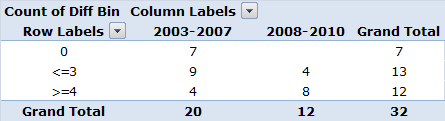
The predictability of outcome of first round series with a game differential of four or more does not stop there. Of greater concern is the alignment of such predictability with the likelihood of an upset. Each of the thirty-two first round matches was categorized as an upset if the lower seeded team won (as indicated by conference seeds one through four, regardless of whether or not a team was moved from one conference to the other under MLS's odd playoff seeding rules). The table below shows the results of each first round playoff series, categorized by whether or not an upset occurred and binned according to the difference in the number of games played.


Clearly, as the game differential increases the likelihood of an upset increases. If a comparison is made between the ratio of upsets in the series with a game differential of four or greater versus the rest of the series, one finds that there is insufficient sample size to determine that the difference is statistically significant. A further breakdown of the matches with a game differential of four or more also yields the table below.


What is interesting is that matches with a game differential of four or more have picked up significantly since the change in the CCL group play format in 2008. In fact, using this calculator to make a comparison of the proportions of the table above shows that a statistically significant difference in the two eras exists if one more series were played in each era and the proportions held. The proportion of matches with a game differential of four or more has certainly increased since 2008.

The proportion of series that ends in an upset has also gone up with era, but not by a statistically significant amount.

Conclusions

In general, it appears as if there is a greater number of first round series with a game differential of four or more games since 2008. Recognizing the challenge such a game differential presents to a team is key in setting realistic expectations for a season. Several key conclusions can be drawn.
  • If a team wins the Supporter’s Shield and/or the MLS Cup one season, they are unlikely to make it out of the first round of the next year’s playoffs. Sorry LA Galaxy and Colorado Rapids supporters.
  • Fans have to be realistic when it comes to setting expectations for success in MLS and other competitions. My fellow Sounders Supporters have the desire to pull off the domestic double and possibly the CCL treble. This is completely unrealistic in MLS – supporters need to pick which competition they want their team to win and not expect the impossible.
  • Sounders supporters, who desire a US Open Cup threepeat, should think twice if they want an MLS Cup. Such a win would put the team back into the CCL and likely cause them cross the crucial four match threshold.
The causes for this correlation are not clear from the statistics, although I do have several theories. Extra-league competitions are the norm the world over. What is not the norm is MLS’s salary cap and the limitations it places on the quality of the players in the league. While overall player quality is impacted, I suspect it is most pronounced in the supporting members of the starting XI and especially in the substitutes that might be expected to see more action in US Open Cup and CCL competitions. I suspect that this limits the quality of the players that teams can rotate through the various competitions they compete within, thus creating a greater reliance on a core XI and more fatigue in the players normally used for league play.

Also likely is a good bit of correlation with overall parity for which MLS is notorious. As the Sounder at Heart blog suggests, they only measure how much parity there is and not whether or not parity is good. Interestingly enough, the English Premier League scores at the opposite end of the parity index. This aligns with less numerical expectations, and illustrates the conundrum I have. I want a meritocratic league where teams are allowed to reward players with the best contracts possible, and I want players to be rewarded financially for their skills. In the same vein, I don’t want to turn the league into such a financial boon that Russian oligarchs or oil sheiks decide to purchase championships for their their clubs with funds from outside their soccer operations and thus drown out other clubs from competing for available talent. In the case of MLS, the seemingly random nature of the league and the increasingly predictable success of the lower seeds in the playoffs suggests that the system needs to be corrected.

The exact nature of that correction can take many forms, but I will attempt to make some suggestions in my next post in this series.

LinkWithin

Related Posts Plugin for WordPress, Blogger...